Replace Missing Teeth with Implants Placed and Restored Under One Roof
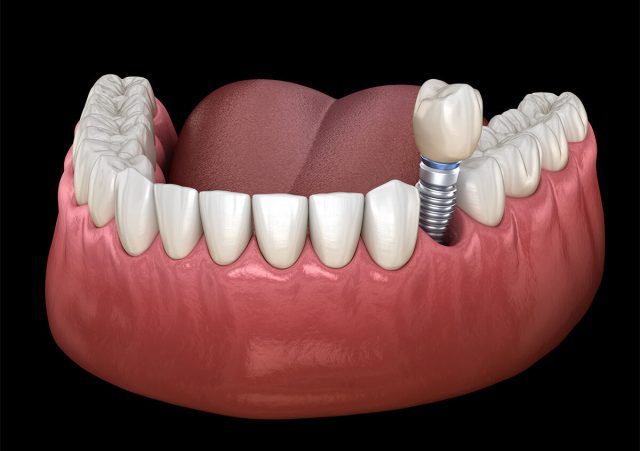
Whether you have lost one tooth or a full arch, a dental implant replaces the tooth root and is finished with a custom crown, bridge, or denture. The result is a replacement that feels, looks, and functions like a natural tooth.
Dr. Evan Olson and the team at Alpine Family Dental plan, place, and restore dental implants right here in our Kalispell office. To talk through your options, call (406) 752-1107 or book a consultation online.
Why Patients Choose Alpine Family Dental for Implants
Choosing where to have implants placed is a big decision. Here is what happens at our office, specifically:
- 3D cone-beam CT imaging. We scan your jaw in three dimensions before treatment so we can measure bone height and width and locate nerves and sinuses. Learn more about our technology.
- Digitally planned, guided placement. Your implant position is planned on the computer first, then placed using that plan as a guide.
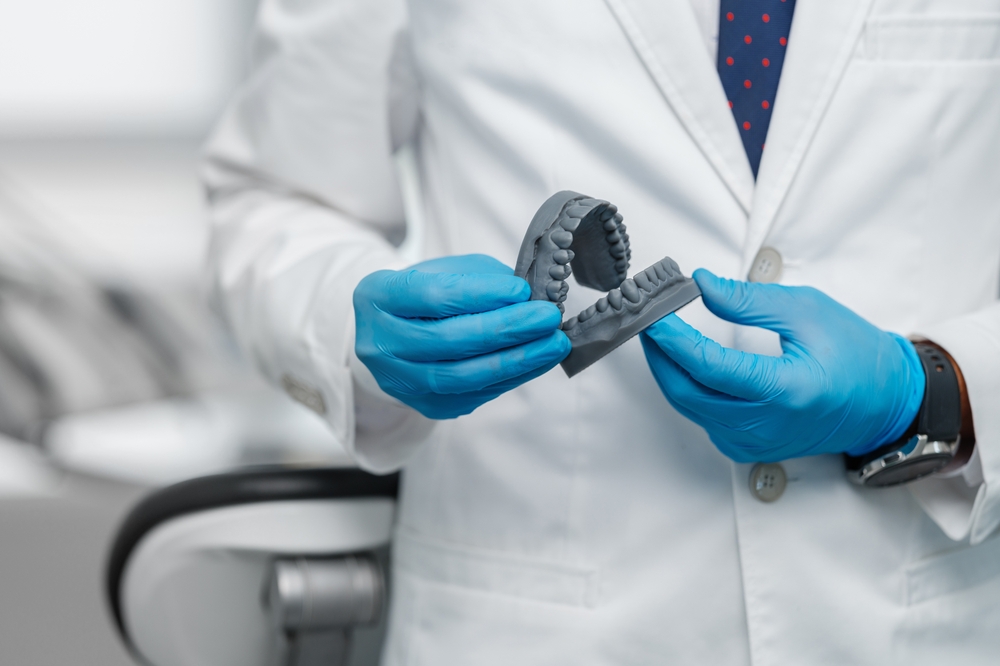
- Crowns made in- office. With CEREC technology and in-house 3D printing, many parts of your restoration are completed on site, which can mean fewer appointments and no waiting on an outside lab for the crown.
- One team from start to finish. Evaluation, any needed extractions or bone grafting, implant surgery, and the final restoration are all handled in-house. See how that works in our post on completing implants fully in-house.
- Comfort options. Sedation, including IV sedation, is available if dental anxiety is a concern. We also use CO₂ laser technology for gentle soft-tissue procedures.

Meet Your Implant Dentist
Dr. Evan Olson, D. ABDSM, followed in his father’s footsteps into dentistry. He earned his degree in Cell Biology and Neuroscience at Montana State University and his dental degree at The University of Iowa College of Dentistry. He then spent five years in a community health setting treating dental emergencies and seven years in private practice in Central Oregon before returning to Montana to lead Alpine Family Dental.
His implant training includes the Implant Pathway Surgical Program (Fellow), Misch Institute, and Pikos Institute. He is a member of the American Academy of Implant Dentistry and the Academy of General Dentistry, and a mentor for the CEREC Doctors training program.

Benefits of Dental Implants
Implants are popular with patients and dentists because they offer several practical advantages over other tooth replacement options:
- Natural look. Crowns are shaded and shaped to blend with your neighboring teeth.
- Confident eating and speaking. Implants are anchored in the jawbone, so they stay put.
- Jawbone support. An implant stimulates the bone where the tooth root used to be, which helps limit the bone loss that follows tooth loss.
- Facial structure. Preserving bone helps preserve the shape of your face.
- Healthy neighboring teeth. A single implant does not rely on adjacent teeth for support the way a traditional bridge does.
- Long-term durability. With good home care and regular checkups, implants are designed to last for many years.
Is an Implant Right for You?
Take our short eligibility quiz to see which options may fit your situation. A member of our team will follow up to answer your questions.
Find out if you may be eligible
Dental Implant Eligibility
"*" indicates required fields
Our Dental Implant Options
Single-Tooth Implant
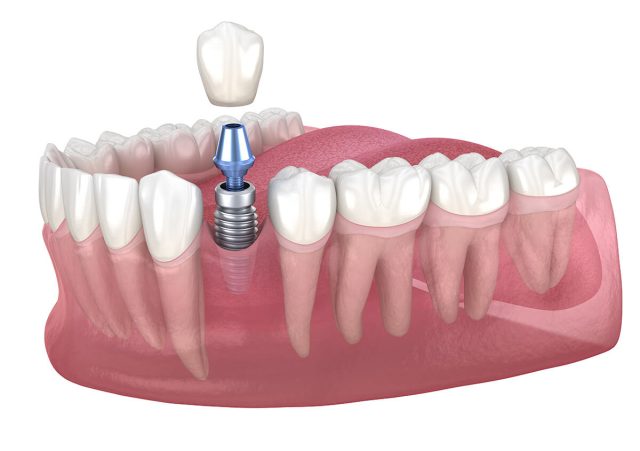
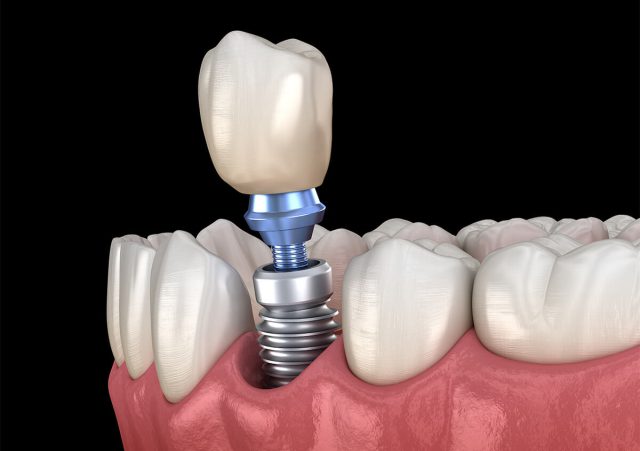
A single-tooth implant replaces one missing tooth and has three parts: a titanium implant post that acts as an artificial root, an abutment that connects the post to the crown, and a custom crown matched to your smile. Because it stands on its own, it protects the health of the teeth on either side.
Implant Bridge
An implant bridge replaces several missing teeth in a row without grinding down the healthy teeth next to the gap. The bridge is anchored to implants instead, which also helps preserve the underlying bone.
Snap-In Dentures
Snap-in dentures pair the familiar design of a traditional denture with the stability of implants. A small number of implants are placed in the jaw, and your denture snaps onto them. It stays secure while you eat and speak, and you can still remove it at home for cleaning.
Full-Mouth and Full-Arch Implants (All-on-4, All-on-6 and All-on-X)
Full-mouth implants replace an entire upper or lower arch of missing or failing teeth with a fixed, implant-supported set of teeth. All-on-4 uses four implants, and All-on-6 uses six. Angling the rear implants lets us use the bone you already have, and many patients can avoid bone grafting.
All-on-X refers to this same approach, with the number of implants chosen to suit your jaw. Dr. Olson will recommend the right number after reviewing your 3D scan.
Immediate Implants
An immediate implant is placed right after a tooth is removed, sometimes in the same visit. It can help maintain the shape of your smile and shorten treatment time. When conditions allow, a temporary tooth may be placed the same day. Not every tooth is a candidate, and we will tell you after your exam and scan.
What to Expect: The Dental Implant Procedure
Treatment begins with an evaluation by Dr. Olson. We review your bone density, gum and oral health, and medical history, and we use digital X-rays and a CT scan to plan treatment precisely. A typical sequence looks like this:
- Pre-surgery steps (if needed). If you have bone loss, a bone graft rebuilds the area first. If a damaged tooth needs to come out, it is removed to make room for the implant. After a bone graft, an implant is typically placed about 4 months later.
- Implant surgery. We numb the area so you stay comfortable, and sedation is available if you want it. We open the gum to expose the bone, place the titanium post, add a healing cap, and close the site with sutures.
- Healing and integration. Over about three to four months, the implant and bone fuse in a process called osseointegration. Careful home care during this time supports a good result.
- Abutment placement. Once the implant has integrated, we uncover it and replace the healing cap with the abutment. The gums then heal for about two weeks.
- Final crown. We take digital impressions and make your custom crown in our office with CEREC technology. When it is ready, it is attached to the abutment, and your restoration is complete.
Once healed, the implant post is designed to be a stable, long-term foundation. The crown is the part that typically wears over time and may need to be replaced after roughly 15 years. Regular checkups and cleanings help your implant last.
Financing Dental Implants at Alpine Family Dental
We want cost to be a planning question rather than a barrier. We accept:
- Cash and check
- Visa, MasterCard, Discover, and American Express
- Health savings accounts (HSA) and flexible spending accounts (FSA)
For payment plans, we work with the following financing partners:
- Cherry
- CareCredit
- Sunbit
- Proceed Finance
Terms, rates, and approval depend on the lender and your credit profile. We also offer an annual dental membership for patients without insurance. See our dental implant financing page for more detail.
Frequently Asked Questions
The area is numbed before surgery, so you should not feel pain during the procedure, and sedation is available if you are anxious. Afterward, some soreness and swelling are common as the area heals. Dr. Olson will give you written aftercare instructions and tell you what to use for comfort based on your health history.
The gums begin to heal within days to weeks, but the implant itself needs about 3 to 4 months to fuse with the jawbone. After that, the abutment is placed, and the gums heal for about two more weeks before your final crown. If you need a bone graft first, plan on about 4 months of healing before the implant is placed. Your timeline depends on your bone, your health, and the type of restoration.
Not everyone does. Bone loss is more likely the longer a tooth has been missing, because the jawbone shrinks without a tooth root to stimulate it. We check your bone with a 3D cone-beam scan before recommending a graft. For full-arch cases, angled implants (as in All-on-4) let many patients use the bone they already have and avoid grafting.
You may be able to, but smoking can slow healing and raises the risk of infection and implant failure compared with non-smokers. Dr. Olson will discuss your situation at your consultation. Cutting back or quitting before and after surgery improves your odds of a good result.
The titanium post is designed to be a long-term foundation. The crown is the part that typically wears and may need replacing after roughly 15 years. Good brushing and flossing, regular dental visits, and avoiding habits such as chewing ice or grinding your teeth (a nightguard can help) all extend its life.
Most adults in good general health who are missing one or more teeth are potential candidates. What matters most is having enough healthy jawbone (or being able to rebuild it with a graft), healthy gums, and a medical history that supports healing. Active gum disease is treated first. Dr. Olson makes the final call after your exam, medical history review, and 3D scan. See our page on dental implant candidacy for more.
Cone Beam
Learn about the Cone Beam CT technology that helps us accurately place your dental implants.
Ready to Smile Again? Start Your Dental Implant Consultation in Kalispell
Missing teeth can change more than your smile. They can make you think twice about sharing a meal, laughing in a photo, or speaking up in a room. You don’t have to keep living that way.
At Alpine Family Dental in Kalispell, Dr. Evan Olson, an Implant Pathway Fellow and member of the American Academy of Implant Dentistry, plans your treatment with 3D cone-beam imaging and places and restores your implants right here in our office. Your first step is a conversation, with no pressure. Call our Kalispell dental office at (406) 752-1107 or book your consultation online. We welcome new patients from Kalispell, Whitefish, Eureka, and across the Flathead Valley.